There is a particular kind of disappointment that comes from finally reaching a legendary website and finding a list of links, half of them broken. The Hidden Wiki has been producing that disappointment for longer than most of its visitors have been online. It is a directory that became famous for what it pointed at, then became infamous for what it refused to stop pointing at, then fell apart and was replaced by copies that kept the name and lost the point.
The short version: the original is gone. It has been gone, in any meaningful sense, since 2014. What remains is a name that anyone can use, a handful of archives, and a large number of sites that would very much like you to believe they are the real thing. This is the longer version.
It began as a wiki, which explains almost everything
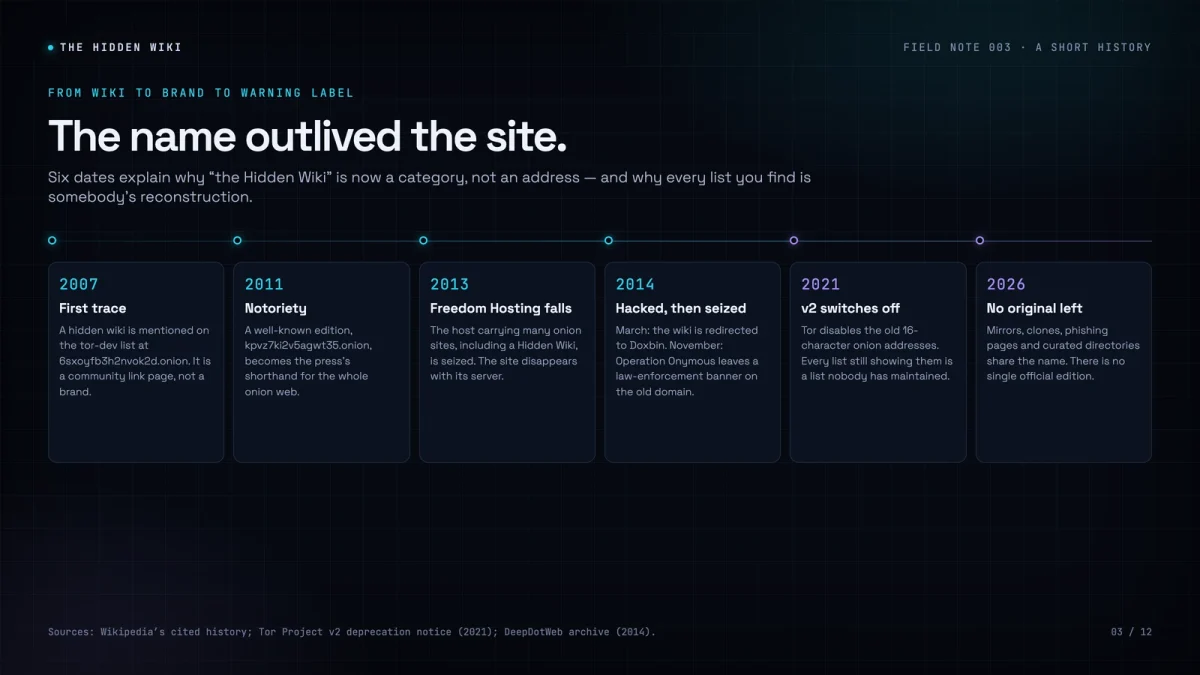
The earliest surviving reference to a hidden wiki on Tor is a 1 June 2007 post on the tor-dev mailing list, which cites “the hidden wiki” at 6sxoyfb3h2nvok2d.onion. That is the earliest documented appearance, not necessarily the founding date. No primary source gives one, and there is no documented line of continuity between the 2007 site and the better-known wiki that followed. At that point the onion web was small enough to keep track of by hand. Tor had made it possible for anyone to publish a site without revealing where it was hosted, and the result was a scattered set of pages with addresses that were impossible to remember.
A wiki was an obvious solution. It was cheap, it was collaborative, and it did not require anyone to be in charge. The site ran on MediaWiki, the same software as Wikipedia, and anyone who registered could edit it. The main page was a directory: categories, short descriptions, and links.
That openness was the point, and it was also the flaw. Wikipedia works because thousands of people argue about citations and a community enforces norms. A directory of anonymous services has no equivalent of a citation. Nobody can verify that the person who added a link is not the person selling the thing behind it. The original Hidden Wiki grew quickly, became useful, and then became a showcase for the worst parts of the network. The name was attached to that reputation before anyone had a chance to decide what it should mean.
The version everyone remembers
By July 2009, a well-known edition at kpvz7ki2v5agwt35.onion was already in use. By 2011 it was the one journalists cited, usually in stories about the parts of the dark web that respectable people were not supposed to know about. The timing was not accidental. 2011 was the year the onion web stopped being a hobbyist experiment and became a news story, and the Hidden Wiki was the most convenient index for reporters who needed an example.
It was hosted by Freedom Hosting, a shared provider that carried a large number of onion sites. That detail matters more than the site’s design. The Hidden Wiki was never a distributed system. It was a database on somebody else’s server, maintained by whoever happened to be editing it, and when the server went away the wiki went with it.
2013: the host falls
In August 2013, the US authorities moved against Freedom Hosting. Its operator, Eric Eoin Marques, was arrested in Dublin. He was extradited to the United States in 2019 and sentenced in 2021 to 27 years in prison for operating an anonymous hosting service used to distribute child abuse material. The details of that case are grim and not the subject of this article. What matters here is the structural effect: when Freedom Hosting went down, a large number of onion sites went down with it, including a version of the Hidden Wiki.
This was the first time the directory’s disappearance was visible to a mass audience. One day the address worked. The next it did not. There was no backup plan, no federation, no mirroring protocol. There was a server, and then there was not.
The copies started almost immediately. Some were built by people who had saved the link list. Some were built by people who wanted the traffic. Some were built by people who understood that a familiar name is a useful thing to put on a phishing page. The original’s disappearance did not create a successor. It created a market.
2014: hacked, then seized
In March 2014, the site was hacked and redirected to Doxbin. In November 2014, during Operation Onymous, its old domain served a law-enforcement seizure banner. By then the name had already begun to fragment. The seizure banner was less an ending than a confirmation: the thing people were looking for had not been a stable institution for years.
The archives are useful here. DeepDotWeb, a dark-web news site that was itself later seized, covered both events. The contemporaneous coverage is a reminder that the Hidden Wiki’s reputation was already a problem before the site vanished. It was known for hosting links that no directory should have hosted, and for having no mechanism to remove them. The takedowns did not fix that. They just moved it.
2021: the addresses stop working
For a while, the old copies could still be reached at their 16-character v2 addresses. That ended in 2021, when Tor retired version 2 onion services. Tor removed v2 from the codebase in July 2021, and Tor Browser stopped accepting the old addresses in November 2021. The Tor Project had announced the deprecation years earlier; the migration was slow, uneven, and in many cases ignored.
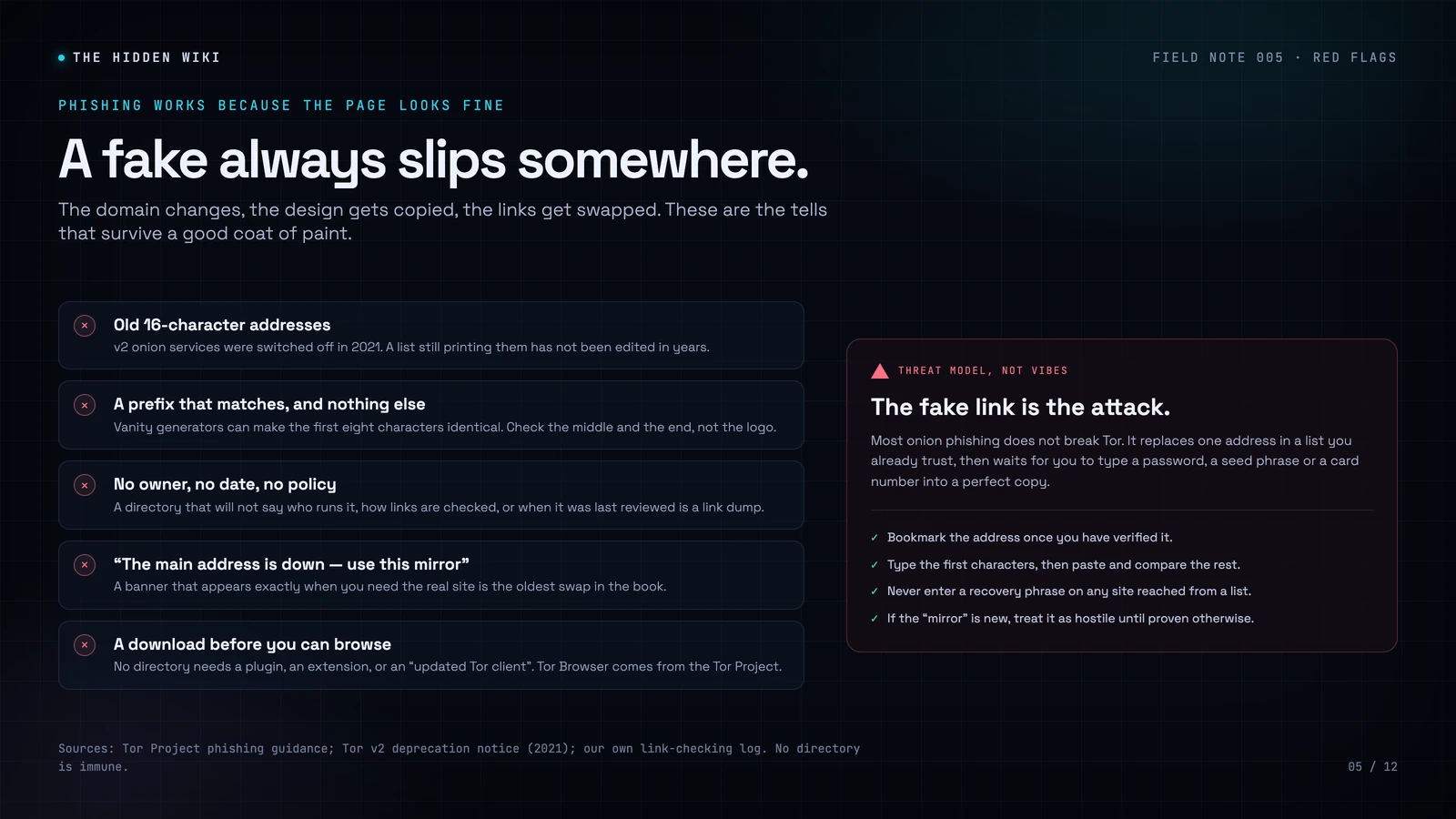
The result is a useful dating tool. If a directory still prints 16-character addresses, it has not been maintained since at least 2021. That does not automatically make it malicious. It does make it useless. A list of dead links is not a directory; it is a monument.
2026: a name, not a website
There is no single official Hidden Wiki today. There is a Wikipedia article about the original, a set of archived pages, a handful of mirrors that may or may not be maintained, a large number of clones, and a smaller number of curated directories that use the name because it is what people search for. The name is not trademarked. Nobody can claim it exclusively. Anyone who says they are the official version is making a claim about themselves, not a statement of fact.
This is why the question “what is the real Hidden Wiki link?” has no good answer. The real one is gone. The useful question is different: which directory can you audit? Does it say who runs it? Does it explain how links are verified? Does it date its work? Does it exclude the things that should be excluded? Those are boring questions. They are also the only ones that separate a directory from a bait page.
The test we apply. A link goes on our page only if the organisation that runs the service publishes the address itself. We compare all 56 characters, check that the service is legal, open it in Tor Browser, and put a date on it. No payment, no exceptions. The method is described in full on The Hidden Wiki homepage.
Why the copies keep coming
The economics are simple. “Hidden Wiki” is a search term with decades of accumulated curiosity behind it. A new domain can capture some of that traffic with a copied layout and a list of links. If the operator is lazy, the result is a stale directory. If the operator is ambitious, the result is a phishing funnel: keep most of the links real, swap one address for a lookalike, and wait.
The strange part is that the copies are not necessarily worse than the original. The original was unmoderated, often wrong, and hosted content that should never have been listed. A careful clone with a policy and a review date is an improvement. The name is not a guarantee of quality. It never was. The only guarantee is the work behind the page, and that is not visible from the logo.
What to do with this history
If you came here looking for a link to the original, the honest answer is that there is nothing to link to. If you came looking for a directory, use one that shows its work. Start with the organisation’s own site when you can. When you cannot, use a directory that tells you where it got the address and when it last checked. Then bookmark the address and stop searching for it.
The Hidden Wiki is a useful case study in how internet institutions age. It was never a company, a foundation, or a protocol. It was a wiki page that became a brand, and the brand outlived every version of the page. That is not a triumph. It is a warning about what happens when a name becomes more durable than the thing it names.
Sources
- Wikipedia: The Hidden Wiki, with its cited primary sources, including the 2007 tor-dev post and 2011–2014 news coverage.
- Tor Project: v2 onion services deprecation timeline.
- RTÉ: Eric Eoin Marques sentenced to 27 years (15 September 2021).
- The Guardian: Freedom Hosting operator jailed (16 September 2021).
- DeepDotWeb archives of the March 2014 hack and November 2014 seizure, preserved by the Wayback Machine.