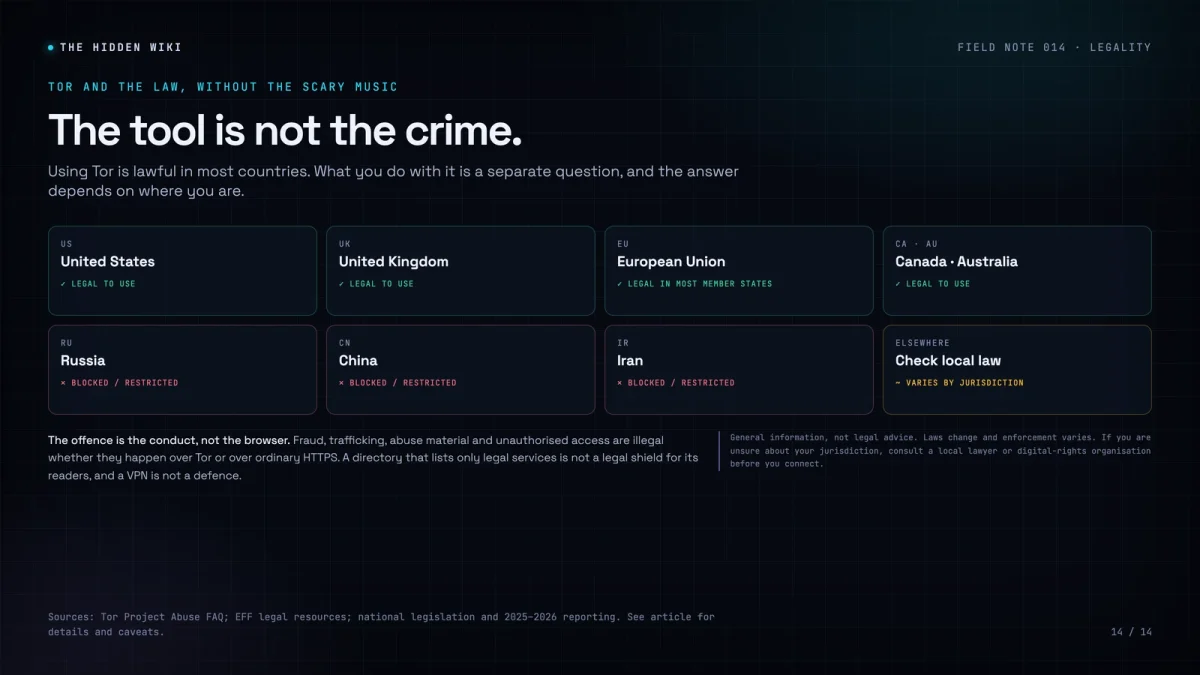
The question usually arrives in the wrong order. Someone asks “is Tor legal?” when what they mean is “can I be punished for what I am about to do?” Those are different questions, and the second one has a much less comforting answer.
In most countries, Tor is lawful. It is a piece of open-source software maintained by a nonprofit, used by journalists, researchers, domestic-abuse survivors, censored readers and people who simply do not want their ISP reading over their shoulder. In a smaller number of countries, the network is blocked, circumvention is regulated, and the legal risk depends on how you connect. Everywhere, the underlying conduct is what the law punishes.
Not legal advice. Laws change, enforcement varies, and this article is a map rather than a ruling. If you are making a decision with legal consequences, talk to a lawyer or a digital-rights organisation in your jurisdiction.
The global rule: the tool is not the offence
No country I could find has a statute that says “using Tor is a crime” in so many words. The laws that matter are about conduct: fraud, drug trafficking, child sexual abuse material, unauthorised access, terrorism, harassment, and the distribution of illegal content. Those offences apply whether the connection runs through Tor, a VPN, a coffee shop’s Wi-Fi, or an ordinary HTTPS session.
This is why the “legal grey area” framing is misleading. There is no grey area around abuse material or fraud. There is a grey area around circumvention in countries that block Tor, and around the obligations of service providers. Those are real legal questions, but they are narrower than the internet usually admits.
Where Tor is lawful, and what that does not cover
In the United States, there is no federal statute that specifically bans Tor. The EFF’s legal FAQ for relay operators, last reviewed in 2023, says running a relay, including an exit relay, is believed to be legal under US law, and it notes that no relay operator has been prosecuted for the relay itself. That does not mean the US is a free-for-all: the Silk Road prosecution, the Playpen investigation, and a long list of ordinary criminal cases show that the government will pursue the conduct and, in some cases, the infrastructure around it.
In the United Kingdom, there is no Tor-specific offence. The Online Safety Act 2023 imposes duties on platforms and has been phased in through 2025, with illegal-content duties from March 2025 and child-safety and age-assurance duties from July 2025. The Act regulates services, not the browser. Prosecutions of dark-web offenders, such as Matthew Falder in 2018, were for the underlying offences, not for using Tor.
In the European Union and Germany, there is no Tor ban. The Digital Services Act applies to platforms, and Germany’s Digital Services Act (DDG) has been in force since May 2024. The EU has spent years arguing over mandatory scanning of private messages — the “Chat Control” saga — but as of October 2026 there is no final mass-scanning mandate. The debate is about provider obligations and encryption, not about criminalising users.
Canada, Australia, India, Brazil and Japan likewise have no Tor-specific prohibition that I could identify. Each has content, computer-misuse, or platform laws that apply to conduct. Australia’s Online Safety Act and its under-16 social-media rules, India’s IT Act blocking powers and CERT-In logging directions, Brazil’s Marco Civil and its 2025 Supreme Court ruling on platform liability, and Japan’s Unauthorized Computer Access Act are all relevant to what people do online. None of them makes Tor itself the offence.
The practical translation: in these jurisdictions, you can install Tor, read a directory, and use an onion service without breaking a Tor-specific law. You can still break the law by what you do there, and you can still be subject to platform terms, employer policies, and border searches.
Where the network is blocked or circumvention is regulated
Three countries deserve separate treatment because the legal risk is not just about conduct. Russia, China and Iran block or restrict Tor, and each regulates circumvention in its own way. The details change often, and the gap between the statute and enforcement can be wide.
Russia has been tightening the rules for years. Federal Law No. 276-FZ, signed in July 2017, requires VPNs and anonymisers to block prohibited content and created a registry of blocked resources. Tor was blocked in December 2021, and the blocking has expanded since, including efforts against bridges and pluggable transports in 2024. In July 2025, a new law introduced fines for intentionally searching for content deemed extremist, including via VPN, and made VPN use an aggravating circumstance in sentencing. In April 2026, Russian platforms began blocking VPN users. The Kremlin has simultaneously said that merely using a VPN is not punishable, which is a useful reminder that the law on paper and the enforcement in practice are not the same thing.
China blocks Tor as part of the Great Firewall. There is no statute that says “Tor is illegal”, but providing tools for intruding into or illegally controlling computer systems is a crime under Article 285(3) of the Criminal Law, and the 2017 judicial interpretation sets thresholds for “serious” cases. In practice, the risk falls hardest on people who sell or distribute circumvention tools; a 2018 Shanghai case involved a programmer who sold VPN accounts and received a suspended sentence and a fine. The revised Cybersecurity Law, adopted in October 2025 and effective in January 2026, adds another layer of regulation. User-side enforcement is less consistently documented, but the direction is clear.
Iran filters Tor and has criminalised the sale and distribution of VPNs, with reports that unlicensed VPN use was criminalised in 2024. Enforcement is opaque, and the country has repeatedly imposed severe internet shutdowns, including an 88-day near-total shutdown in 2026. In that environment, the legal question is inseparable from the political one: the risk is not a fine for using a browser, it is being identified as someone who is trying to get around the state’s filtering system.
If you are in one of these countries, the honest summary is: the law is uncertain, the enforcement is discretionary, and a bridge may be a technical necessity and a legal risk at the same time. Do not rely on a blog post, including this one, to decide what is safe.
The parts that apply everywhere
Three issues cut across borders and are worth separating from the Tor question.
Border searches. Many countries allow officials to search devices at the border, sometimes without a warrant. If you are travelling with a laptop or phone, assume that the contents may be examined. The practical response is to carry less: a clean device, no sensitive client data, and a plan for what to do if a device is seized. Tor does not protect data at rest.
Employer and network policies. A university, employer or hotel can prohibit Tor on its network without breaking any law. That is a policy matter, and the consequences are usually administrative rather than criminal. It still matters if your job or your visa depends on it.
Provider obligations. If you run a service, the legal questions are different: content liability, data retention, copyright, and platform regulation. The EU’s DSA, the UK’s Online Safety Act, India’s IT Rules and Brazil’s platform regime all impose duties on intermediaries. A directory is a publisher of links, and the rules that apply to it are not the same as the rules that apply to a reader.
What this means for a legal-only directory
Our policy is not a legal strategy; it is an editorial one. We list news, search, email, whistleblowing, libraries and digital-rights services because those are the services we can verify and defend. We do not list marketplaces because most of them sell illegal goods, many are scams, and a directory that points people toward them is doing harm that no disclaimer can undo.
The legal picture reinforces that choice, but it is not the only reason. A directory that lists everything ends up being useful to the worst actors and useless to everyone else. A directory that lists a narrow, legal set can be checked, maintained, and recommended without an asterisk.
Tor is legal in most places. What you do with it is legal in far fewer. The difference is the whole conversation.
A short checklist
- Check the law where you are, not where the server is. The location of the service does not determine your legal exposure.
- Do not confuse a tool with a permission slip. Tor does not make an illegal act legal, and a VPN does not either.
- Assume border devices are searchable. Travel with less, and keep sensitive data off the machine.
- Read the platform rules. Employer, school and hotel networks can ban Tor without any statute.
- If you are in Russia, China or Iran, get local advice. The law is unsettled, enforcement is discretionary, and the consequences can be severe.
- If you run a service, get advice on intermediary liability. The rules for publishers are not the rules for readers.
Sources
- EFF: Legal FAQ for Tor relay operators.
- UK Government: Online Safety Act collection.
- European Commission: Digital Services Act.
- Human Rights Watch: Russia’s 2017 anonymity law.
- Tor Project: Tor censorship in Russia.
- Meduza: Russia’s July 2025 fines law.
- ARTICLE 19: The right to online anonymity.
- 21st Century Business Herald: the 2018 Shanghai VPN case.
- HRANA: Iran partially back online after the 2026 shutdown.
- Access Now: Encryption makes us safer.