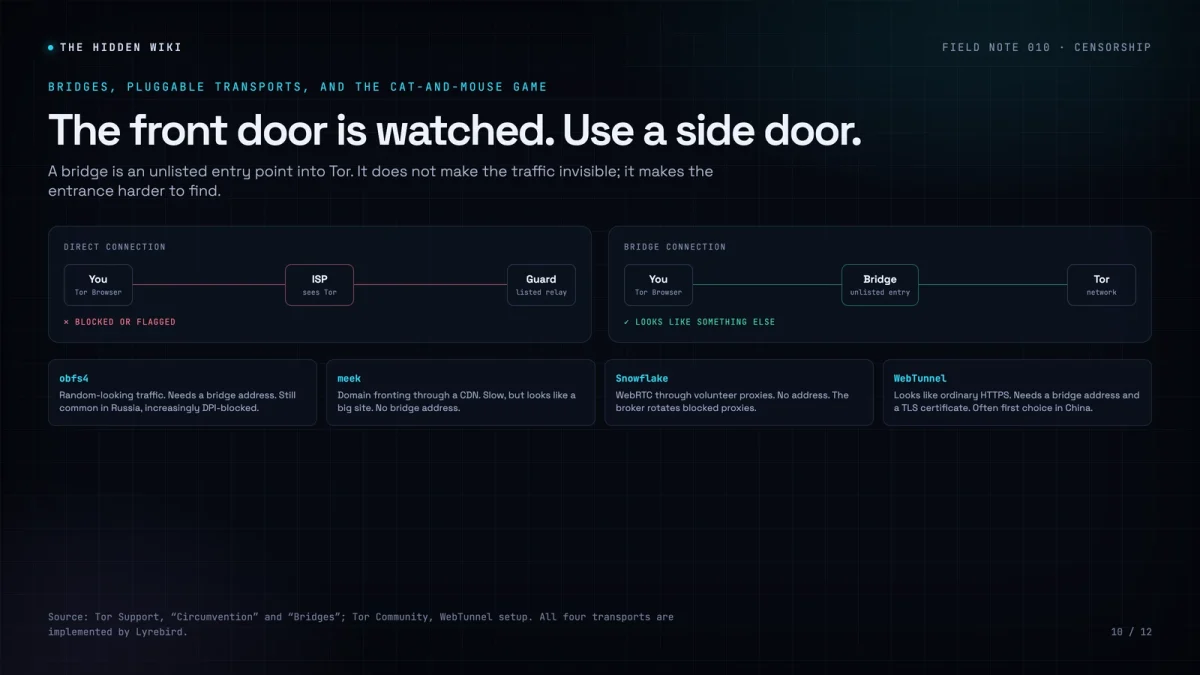
Tor has a public list of entry points. That is the price of being a public network: directory authorities publish the relays, clients download the list, and anyone watching the network can see a connection to a known Tor guard. Bridges exist to break that visibility. They are unlisted entry points, handed out through a separate channel, and designed to look like something other than Tor.
They are also the most over-mythologised part of the ecosystem. A bridge is not a stronger version of Tor. It does not make you more anonymous against a global adversary, and it does not make illegal activity legal. It solves a specific problem: your network is blocking the public entry points, and you need another way in.
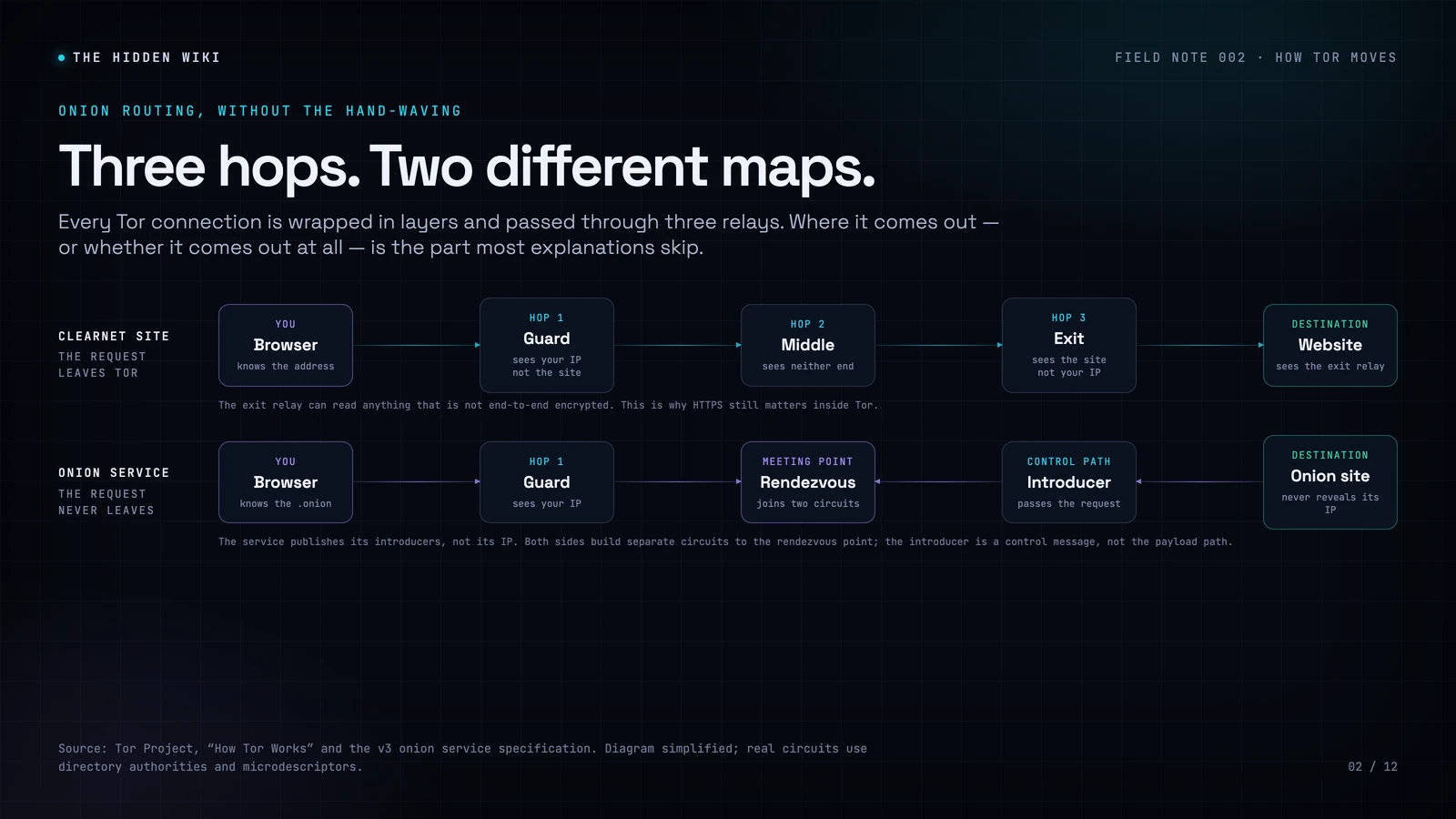
What a bridge actually is
A bridge is a Tor relay that is not listed in the public directory. Instead of connecting to a known guard, Tor Browser connects to a bridge address you supply, or one it obtains through a bridge distribution service. The bridge is still a Tor relay. It still forwards your traffic into the network. The difference is that your ISP cannot simply look up the destination and see “Tor”.
That is the whole trick, and it is an arms race. Once a censor learns a bridge address, it can block it. Bridges are therefore distributed sparingly, rotated, and paired with pluggable transports that change what the connection looks like on the wire.
The four transports you will actually see
Tor currently ships four pluggable transports. They are all implemented by Lyrebird, the transport binary that replaced obfs4proxy. Each makes a different trade between looking innocuous, being fast, and surviving deep packet inspection.
obfs4 makes the traffic look random. It resists active probing: a censor who connects to the bridge cannot easily confirm that it is a Tor bridge. It needs a bridge address, and it is still the most-used transport in Russia, though some mobile ISPs have learned to block it. If you have an obfs4 bridge line, it is still worth trying first.
meek uses domain fronting. The connection goes to a large CDN and appears to be traffic to a major website, while the actual destination is hidden inside the request. It is slow, bandwidth-limited, and does not need a bridge address. It is the transport of last resort when everything else is blocked, not the one you want for video.
Snowflake routes your traffic through volunteer browsers using WebRTC. You do not need a bridge address; the Snowflake broker matches you with an available proxy, and it can rotate proxies when one is blocked. It is elegant and resilient, and it depends on volunteers actually running the proxy. During censorship events, Snowflake usage tends to spike.
WebTunnel makes the connection look like ordinary HTTPS to a website. It needs a bridge address, and the bridge operator needs a domain, a valid TLS certificate, a web server, and enough RAM to run the relay. It is more work to operate than the others, and it is often the first recommendation in China because it blends in with the HTTPS traffic that the firewall cannot block wholesale.
How to get a bridge
Tor Browser can request bridges automatically through Moat, the built-in bridge distribution channel. If that does not work, you can use bridges.torproject.org, the Telegram bot @GetBridgesBot, or email [email protected] from a Gmail or Riseup account. The email autoresponder will send you a set of lines.
Bridge lines look like a short block of text with an address, a port, a fingerprint, and a certificate. Paste the whole line into Tor Browser’s bridge settings. Do not retype it, and do not trust a bridge line you found in a forum post. A malicious bridge can see that you are connecting, and a fake bridge line is a way to send you to an adversary-controlled entry point.
What bridges do not do
They do not hide that you are using Tor from your own machine or your local network. A bridge changes the destination your ISP sees, not the fact that Tor Browser is running. If your threat model includes someone with access to your device, a bridge is irrelevant.
They do not protect you from a global adversary. Tor’s own documentation is clear that an observer who can see both ends of a connection can correlate traffic by timing and volume. Bridges raise the cost of blocking. They do not defeat end-to-end correlation.
They do not make prohibited activity lawful. If circumventing censorship is itself illegal where you are, a bridge does not change that. It may attract more attention, not less. Check your local law before you use one.
They do not always work. Censors block transports, not just addresses. When obfs4 is fingerprinted, WebTunnel may work. When WebTunnel is blocked, Snowflake may work. The correct response to a blocked bridge is to try a different transport, not to conclude that Tor is broken.
A bridge is a side door. It gets you into the same building. It does not change what you do once you are inside.
Why this matters for a directory
If you cannot reach the Tor network, you cannot reach any onion link, no matter how well it is verified. That is why bridge guidance belongs in a directory’s basic instructions rather than in an advanced section. The reader who needs it usually needs it urgently, and the reader who does not need it will skip the paragraph.
It also matters for the directory’s own availability. This site is on the clearnet, so you can read it without Tor. The links it publishes are not. If Tor is blocked where you are, the directory is still readable, but it is not usable until you solve the connection problem. That is a feature, not a bug: the directory should not require the very tool it is describing.
The censorship map, in broad strokes
China blocks Tor as part of the Great Firewall, and the legal risk of using circumvention tools there is significant. Iran filters Tor and has repeatedly disrupted internet access during protests. Russia has passed laws requiring VPNs and anonymizers to block prohibited content, and has blocked Tor entry points at various times. The details change frequently, and a transport that works today may not work next month.
Outside those cases, Tor is generally legal and generally reachable. The United States, the United Kingdom, Canada, Australia and most of the European Union do not prohibit it. Some networks — corporate, school, hotel — block it as a policy matter, which is annoying but not the same as a national firewall.