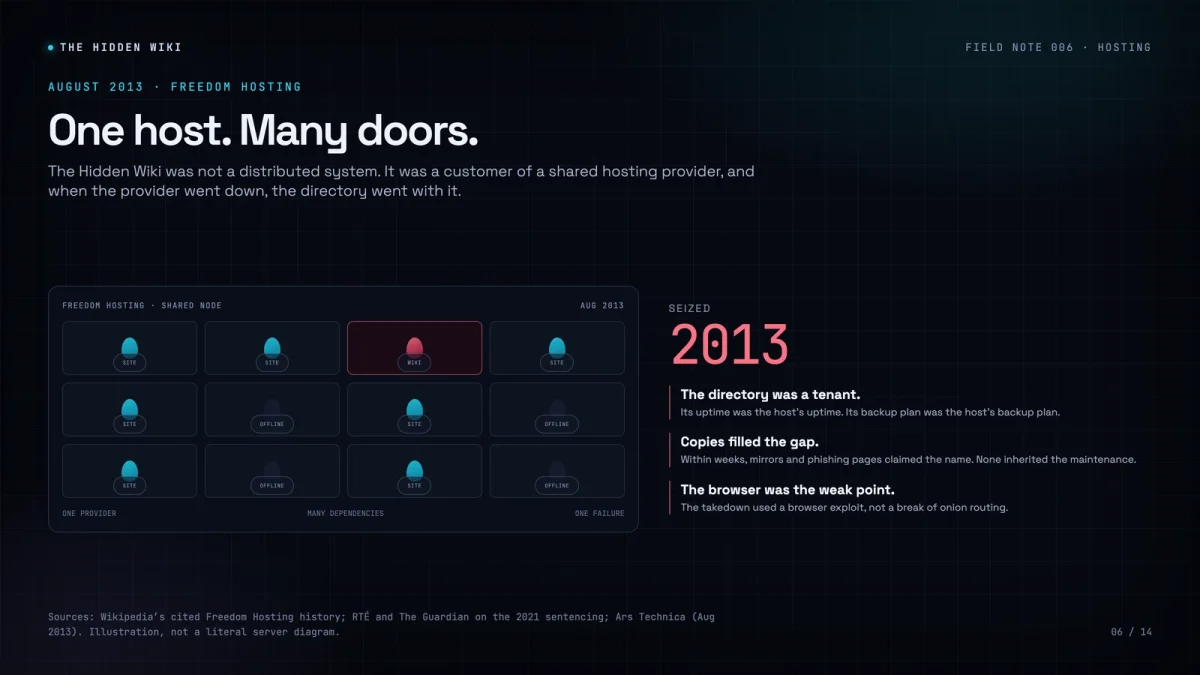
The Hidden Wiki did not die because someone decided to shut it down. It died because the company hosting it was taken apart in a single week, and the wiki happened to be one of the sites on its servers. That distinction is the whole story. The directory was never a distributed network. It was a customer.
What Freedom Hosting was
Freedom Hosting was a free, anonymous hosting service for Tor hidden services. It did the unglamorous work that made a lot of the early onion web possible: it kept servers running, handed out subdomains, and asked almost nothing about what customers were publishing. At its peak it was widely described as the largest host of onion sites, though the exact number is impossible to verify and the estimates were always rough.
It was run by Eric Eoin Marques, an Irish-American dual citizen born in New York in 1985 and living in Dublin. The service was free, which is worth pausing on. Free hosting for anonymous sites is not a sustainable business. It is a subsidy, and someone has to pay for it, whether through donations, advertising, or the tolerance of a hosting provider that does not ask questions. The economics shaped the service’s trajectory as much as the law did.
The important thing for our purposes is not the operator. It is the architecture. Freedom Hosting concentrated a large share of the onion web onto a small number of machines. That made it efficient. It also made it a single point of failure for every site that used it, including the best-known edition of the Hidden Wiki.
The first week of August 2013
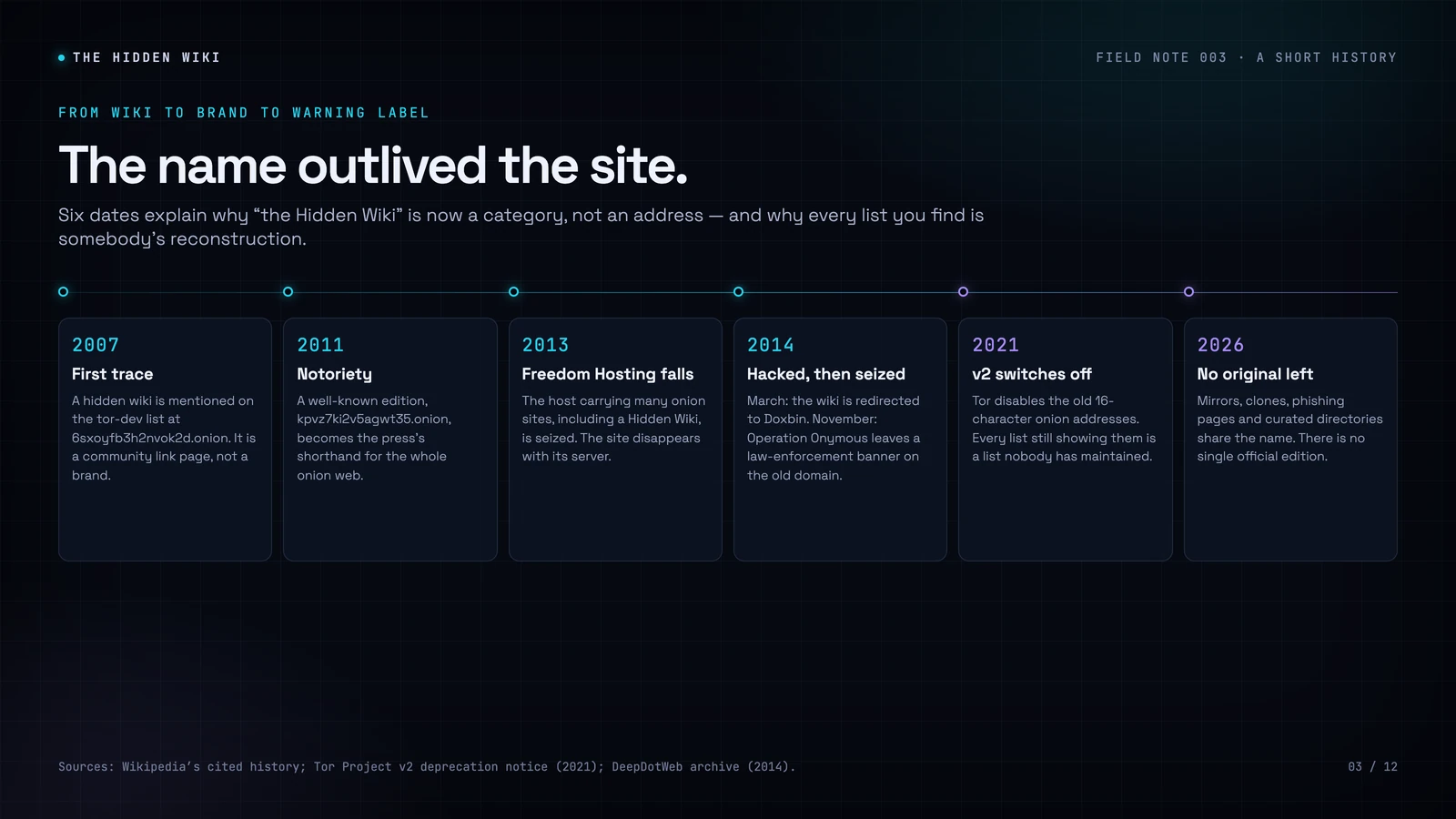
In the first week of August 2013, the servers were taken over. Visitors to a number of onion sites hosted by Freedom Hosting were served a page saying the site was down for maintenance. The page contained JavaScript that exploited a vulnerability in Firefox 17, the browser version used by the Tor Browser Bundle at the time. The payload attempted to identify visitors and report back to a server outside Tor.
This is the part of the story that gets simplified into “the FBI hacked Tor”. It did not break the onion routing protocol. It attacked the browser, which is a much easier target. Tor can hide where a request comes from. It cannot stop a malicious page from running code in a browser that has an unpatched vulnerability, and it cannot stop that code from making a network connection if the exploit succeeds.
Marques was arrested in Dublin. He was extradited to the United States in 2019 and sentenced in September 2021 to 27 years in prison for operating an anonymous hosting service used to distribute child abuse material. The sentence was reported by RTÉ and The Guardian, among others. The case is a useful reminder that “anonymous hosting” is a legal category, not a magic trick: the operator was known, arrested, and prosecuted.
The lesson was not that Tor had failed. It was that a directory which depends on one hosting company has the same uptime as that company, and the same legal exposure.
What happened to the Hidden Wiki
The Hidden Wiki was one of the sites affected. Its address stopped resolving, and the site disappeared with the servers. There was no migration plan, no signed backup, and no way for readers to know whether the disappearance was temporary or permanent. The site had been a wiki on a server, and the server was gone.
Within weeks, copies began to appear. Some were assembled from cached pages and memory. Some were built by people who saw an opportunity. Some were phishing pages that kept the layout and changed a handful of addresses. The original’s disappearance did not produce a successor; it produced a crowd of claimants, each with a different reason for using the name.
This is the point where the history of the Hidden Wiki stops being the history of a website and becomes the history of a brand. A website can be restored from a backup. A brand can be copied by anyone with a domain and a text editor. The copies did not need the original’s data. They needed its name, and the name was free.
Why centralization is the real vulnerability
The Freedom Hosting takedown is often told as a story about law enforcement versus anonymity. The more useful lesson is about concentration. A hosting provider is a choke point. So is a domain registrar, a certificate authority, a payment processor, a CDN, and a maintainer with the only copy of the database. The onion web was designed to remove some of those choke points, but it cannot remove the ones that site operators create for themselves by using the same provider, the same software, and the same list.
The Hidden Wiki was a directory, which made the concentration worse. A single directory can direct thousands of people to a single host. When the host goes down, the directory’s readers do not just lose one site; they lose the map. And when the directory is copied, the copies inherit the same centralization without inheriting any of the maintenance.
What changed, and what didn’t
In the short term, a lot changed. The takedown accelerated the spread of mirrors, normalized the idea that a Hidden Wiki could disappear overnight, and gave phishing operators a ready-made story: “the main site is down, use this mirror.” That sentence is still one of the most reliable tells of a fake directory, and it works because it describes something that actually happened.
In the long term, less changed than people expected. The onion web did not become more decentralized in any coordinated way. New hosting providers appeared, some more careful than Freedom Hosting and some less. Directories continued to be run by small teams with single points of failure. The technology improved — v3 addresses, better transport, a more mature browser — but the social architecture did not. People still wanted a list, and lists still wanted an owner.
The 2013 takedown also demonstrated that a browser exploit is a more practical attack than breaking Tor. That lesson has been learned by every subsequent operator, which is why modern Tor Browser ships with security levels, disables dangerous features by default in Safer and Safest, and pushes updates aggressively. The weakest point in the chain was never the three relays. It was the code rendering the page.
What it means for anyone using a directory today
Three practical conclusions follow from the story.
First, uptime is not legitimacy. A site that has been online for years may simply have a stable host. A site that disappears may have been legitimate. The only way to judge a directory is by its disclosed method and its dates, not by how long the domain has existed.
Second, a mirror is not a backup. If a directory cannot survive its host disappearing, it is not resilient. If it asks you to trust a new domain because the old one is down, it is asking you to skip the one check that matters. Get the address from the organisation, not from the rescue banner.
Third, the browser is part of the threat model. The Freedom Hosting payload did not need to deanonymize Tor. It needed a browser vulnerability and a user who opened the page. Keep Tor Browser updated, use the security level you actually need, and do not open documents or run plugins from sites you do not trust.
The Hidden Wiki’s disappearance in 2013 was not a unique event. It was the first widely visible example of a pattern that has repeated ever since: a useful site, a concentrated dependency, a sudden removal, and a crowd of copies fighting over the name. The pattern is more important than the site.
Sources
- Wikipedia: Freedom Hosting, with cited contemporaneous coverage.
- RTÉ: US court sentences Irish man to 27 years (15 September 2021).
- The Guardian: Freedom Hosting operator jailed (16 September 2021).
- Ars Technica: researchers say Tor-targeted malware phoned home (August 2013).
- Tor Weekly News, 7 August 2013.